



BRACKET CLOCK MINIATURE Barwise London Circa 1810 England
M&R29
BRACKET CLOCK MINIATURE
Signed: Barwise London
Circa 1810
England
Movement
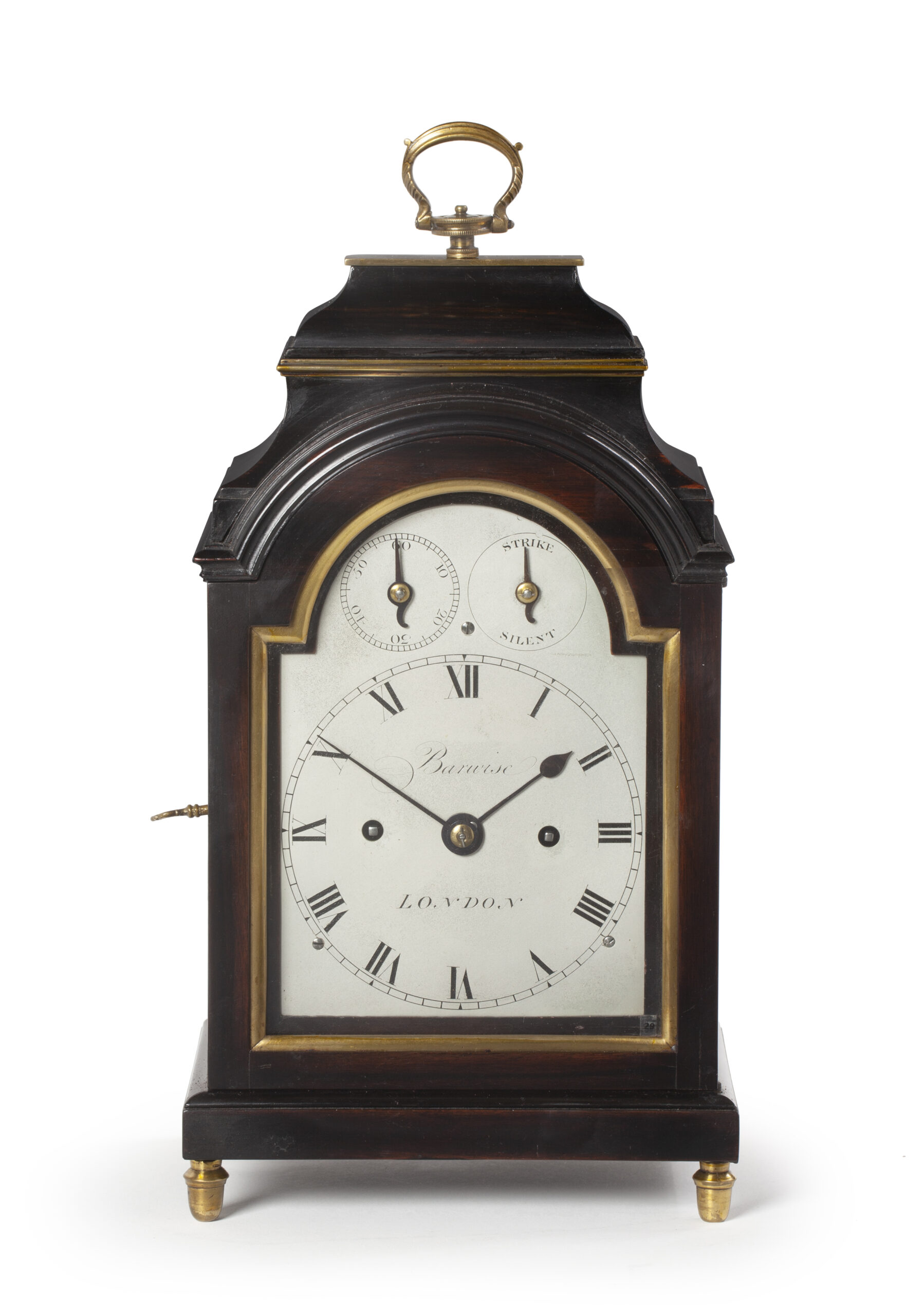
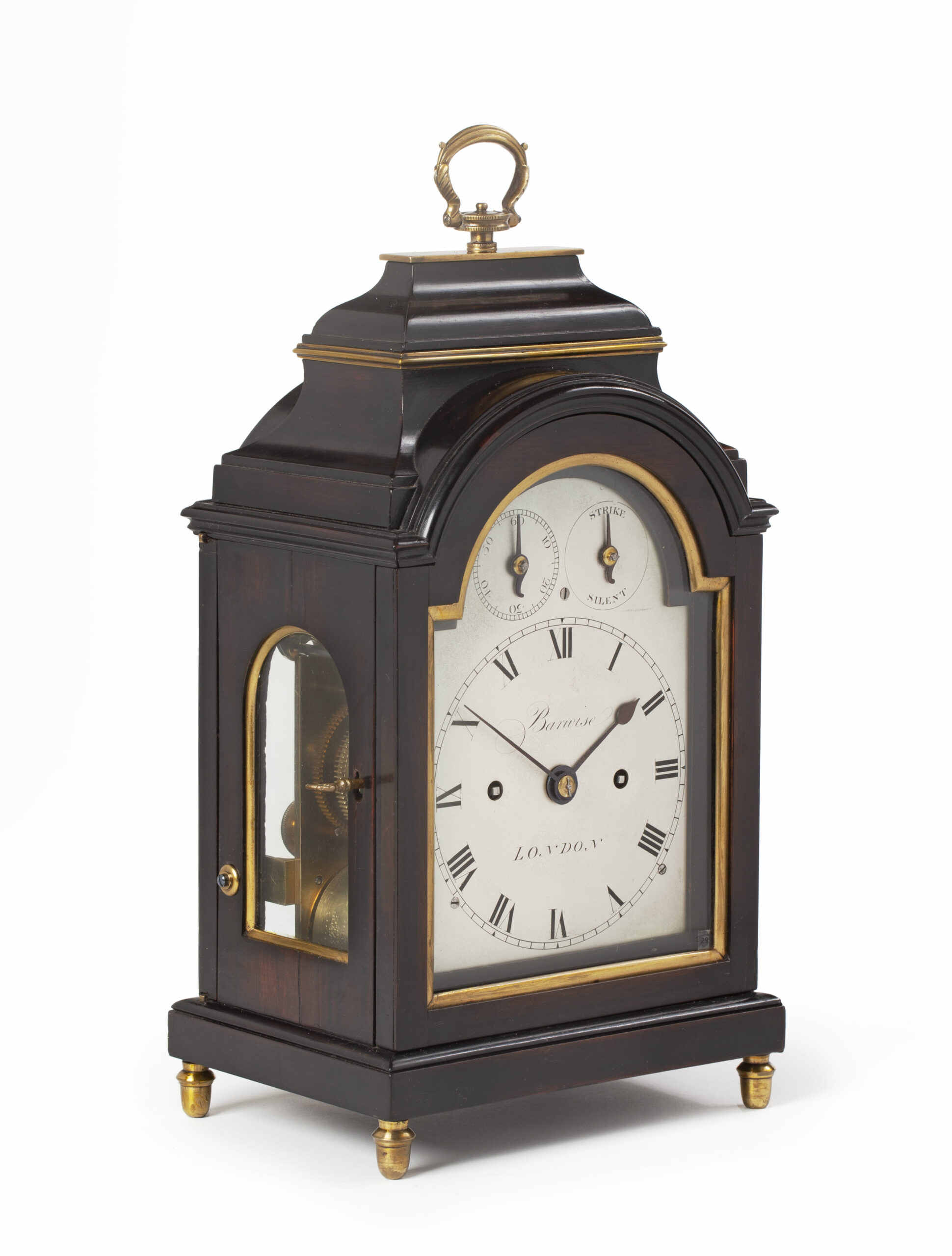
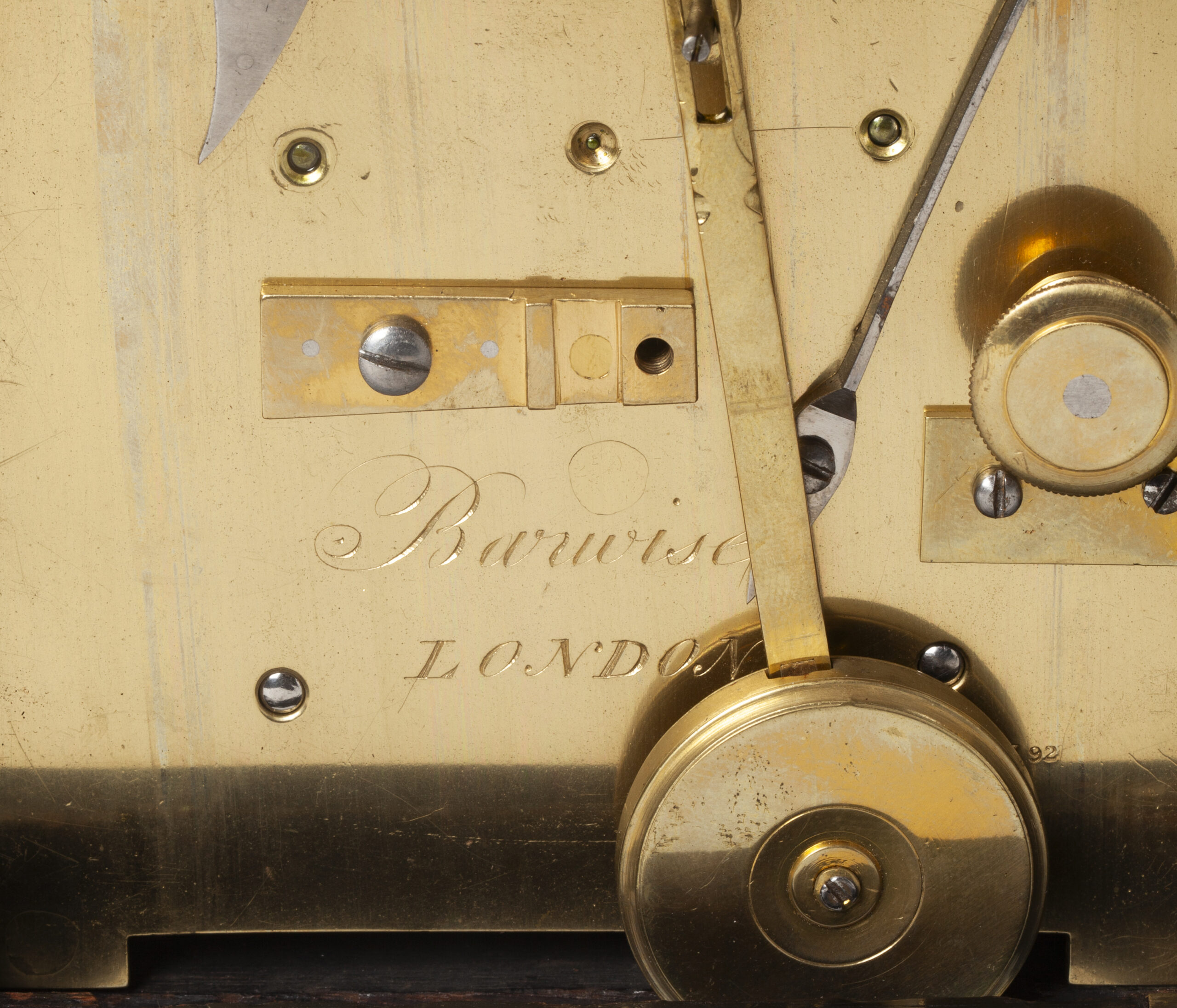
The spring-driven eight-day chain-fusee brass movement is constructed between two plates and consists of going and striking trains. The going train has an anchor escapement and a short pendulum. The striking train that strikes a bell on the hour. The movement is signed on the back: Barwise London.
Dial
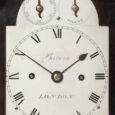
The arch-shaped, matt silvered dial has a black Roman chapter ring with Arabic five minute and minute divisions. The time is indicated by a fine pair of pierced blued-steel hands. Within the arch are two small numeral rings: left for the regulation of the going train and right for striking/not striking. The winding holes for the going and striking trains are placed near the III and the IX and in the center the engraved signature Barwise London.
Case
The ebony-veneered case with a profiled bell top is crowned by an elegant brass handle. The front and back are fitted with an arched door, and both sides have an arched window. The whole rests on four brass feet.
Duration 1 week
Height 29/27 cm. (handle up/down)
Width 15 cm.
Depth 11 cm.
Literature
Brian Loomes, Watchmakers and Clockmakers of the World, London, 2006, p. 304
The maker
The life of John Barwise and his family are outlined by A.D. Stewart in his article Barwise & Sons: Watchmakers to the King, A brief history of family and firm published in the March 2014 issue of ‘ANTIQUARIAN HOROLOGY’ (Vol IIIV No. 1 pages 621-34). Stewart notes that John Barwise was born into a clockmaking family in Cockermouth, Cumberland in around 1756. By 1780 he had moved to London where he opened a watch retailing business. Ten years later he married Elizabeth Weston with his address being recorded as 29 St. Martin’s Lane where he remained until his death in 1820.