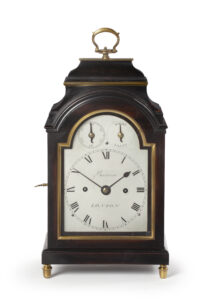
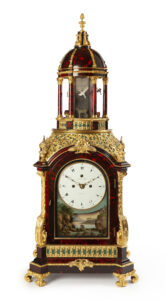
TABLE REGULATOR Signed and numbered: Janvier No:53 Ca. 1822 France
M&R29a
TABLE REGULATOR
Signed and numbered: Janvier No:53
Circa 1822
France
Movement
The spring-driven eight-day brass movement consists of going and striking trains. The going train has pin escapement (deadbeat) and a sophisticated compensation pendulum. The striking train, regulated by a countwheel, indicates the hours fully and the half hours with one stroke on a bell. The movement has a central sweep seconds hand and is signed and numbered on the back plate: Janvier No:53.
Dial
The circular, white enamel dial has a black Roman chapter ring with strokes as minute markers, with those for the five minutes being more pronounced. The winding holes are situated in the centre of the dial near the IIII and VIII. The time is indicated by a pair of sawn-out fire-gilt brass hands. The blued steel seconds hand has a separate seconds ring on the inside of the hour ring. The dial is protected by a convex glass set in a fire-gilt bezel. The door can be opened by a concealed lock on the right side of the case.
Case
The austere, moulded mahogany case has glass panels on all four sides. The top is glazed. The back door can be opened from the side. The dial is decorated with two spandrels in the top corners and suspended from the bottom of the dial is a cast and chased lambrequin with tassels; all ornaments are made of fire-gilded cast brass. The base and the top of the case have mouldings. It rests on four rectangular feet.
Duration: 1 week.
Height: 46 cm.
Width: 25.5 cm.
Depth: 20.5 cm.
Literature: Tardy, Dictionnaire des Horlogers Français, pp. 323-24.
The maker
Antide Janvier (1751-1835), like Bourdier and other prominent eighteenth-century clockmakers, was dedicated to the science of horology. Janvier made precision clocks of almost unparallelled accuracy and, like Abraham-Louis Breguet (1747-1823), created some of the world’s most complex and sophisticated clocks, of which this small table regulator is a fine example. As official clockmaker to Louis XVI, Janvier was given lodgings and a workshop in the Louvre, from where he supplied clocks for the royal palaces. During the Revolution, Janvier and another royal clockmaker, Robert Robin (1742-1809), were imprisoned; however, Janvier was later employed by the new government to advise on a new decimal system of timekeeping.
Antide Janvier was born on 1 July 1751 in Lavans-lès-Saint-Claude in Bourgogne-Franche-Comté, northeast of Geneva, and died in 1835. He was apprenticed to Abbé Jacques-Joseph Tournier (1690-1766), the inventor of a method for a counting device. At a very young age, Janvier became interested in mechanical instruments and astronomy. When he was 15, he made a globe with mechanically moving celestial bodies around it. He presented this to the “Academie des Arts et Belles-Lettres de Besançon”, where he was awarded a certificate during a special session on 24 May 1768. Sometime later, Janvier moved to Besançon. Here he carried out important restorations, such as on a table clock made for Cardinal Granvelle in Augsburg 1564. Back in Saint Claude, he was presented to several royal highnesses and subsequently became a purveyor to the court. In Verdun he founded a school of clockmaking and married Anne-Catherine Guyot, daughter of a bookseller. After an eventful life in which he made numerous clocks, Antide Janvier died on 21 September 1835 in the Cochin hospital in Paris.