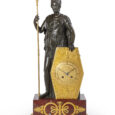
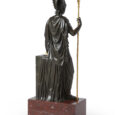
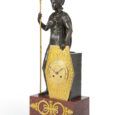
MANTEL CLOCK ‘Pallas Athena’ Ca. 1820 France
M&R90
MANTEL CLOCK ‘Pallas Athena’
Circa 1820
France
Movement
This superb ormolu and bronze mantel clock depicting Pallas Athena has a spring-driven movement, consisting of going and striking trains, which is situated in the base and the statue. The going train has an anchor escapement and a short pendulum with silk suspension. The striking train, which is regulated by a countwheel, indicates the hours fully and the half hours with one stroke on a bell, which is mounted on the backplate.
Dial
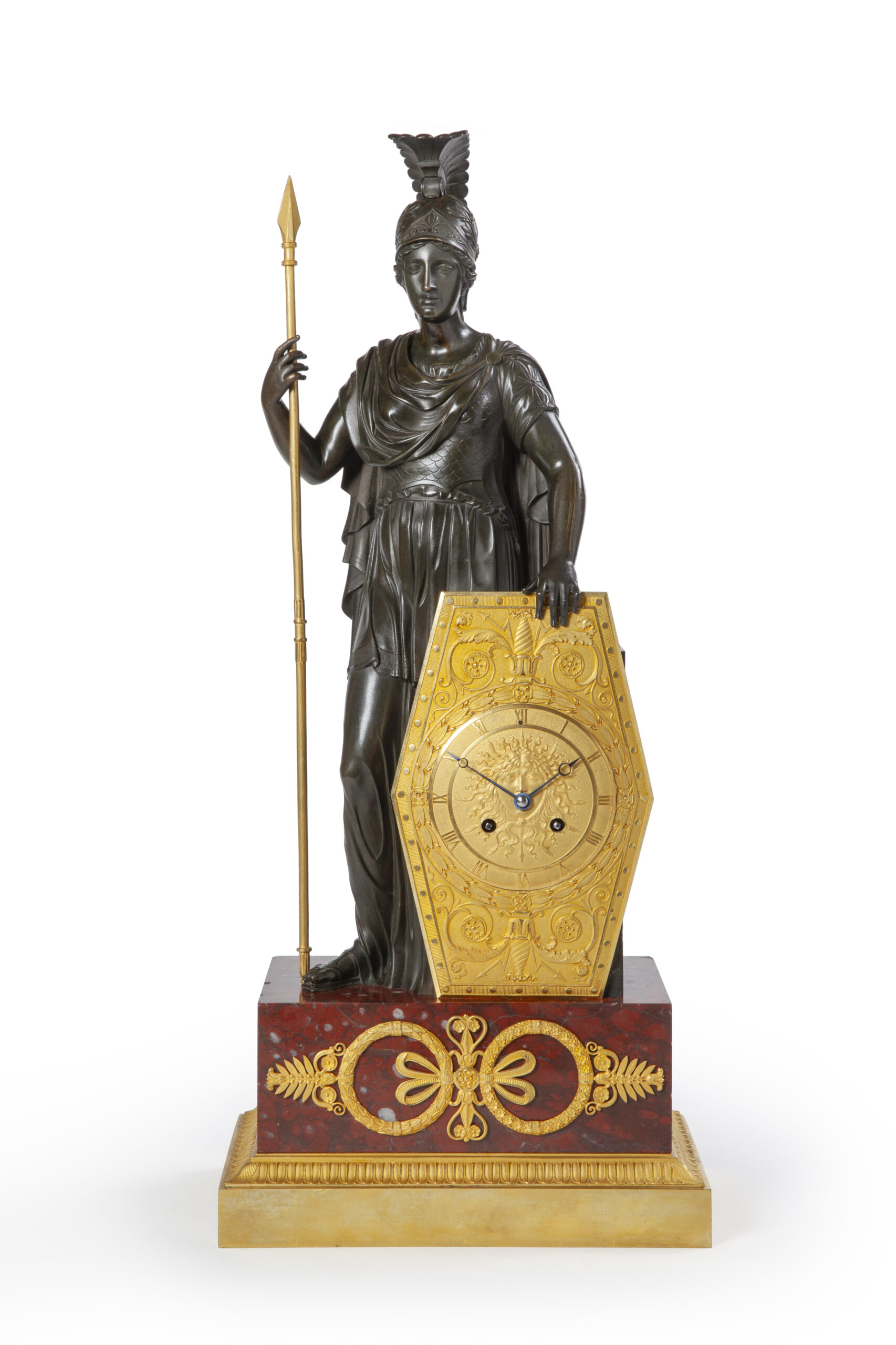
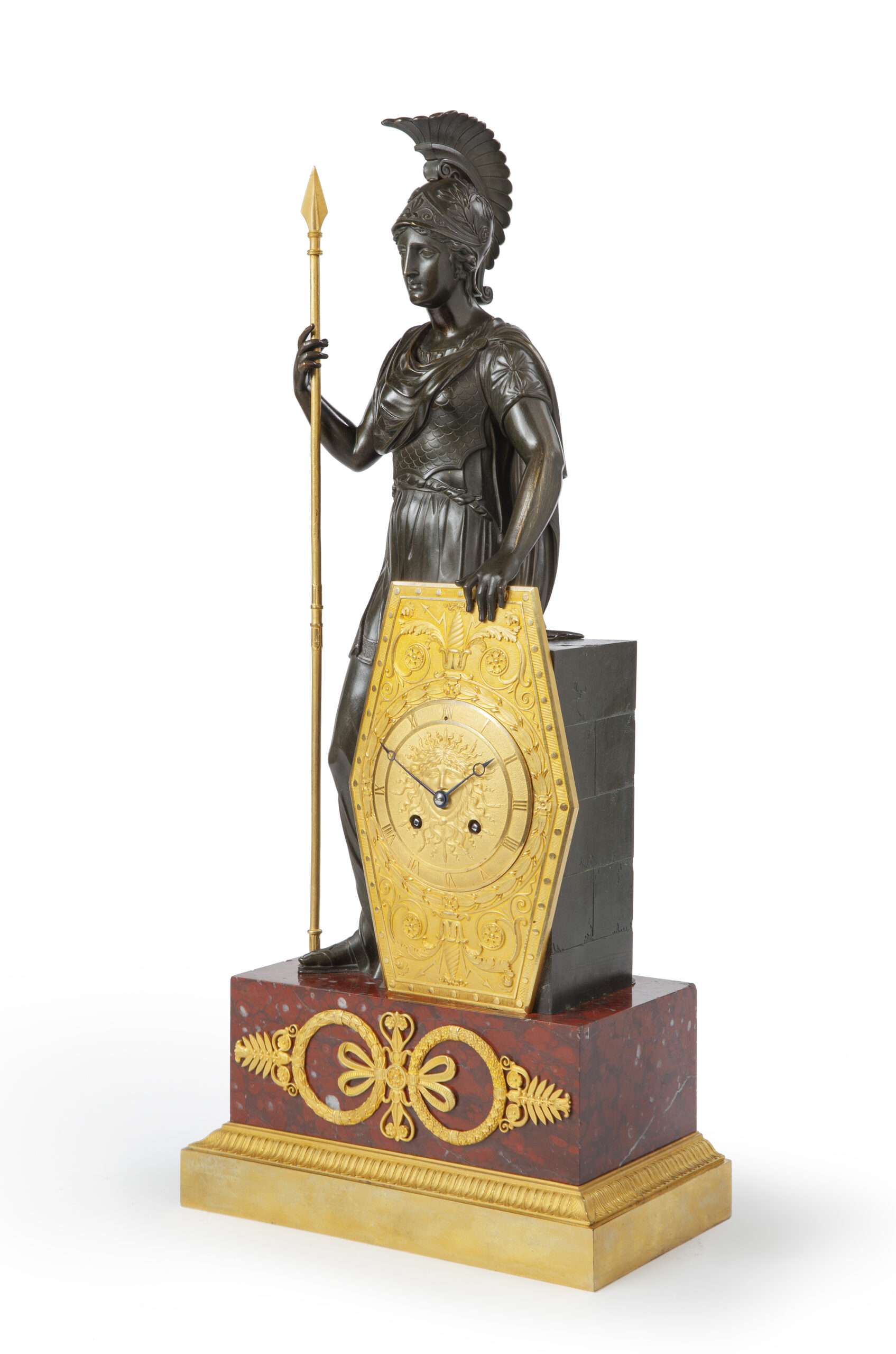
The gilt bronze shield-shaped dial has a Roman chapter ring, on which the time is indicated by two blued steel Breguet hands. In the middle is relief of a sunburst head.
Case
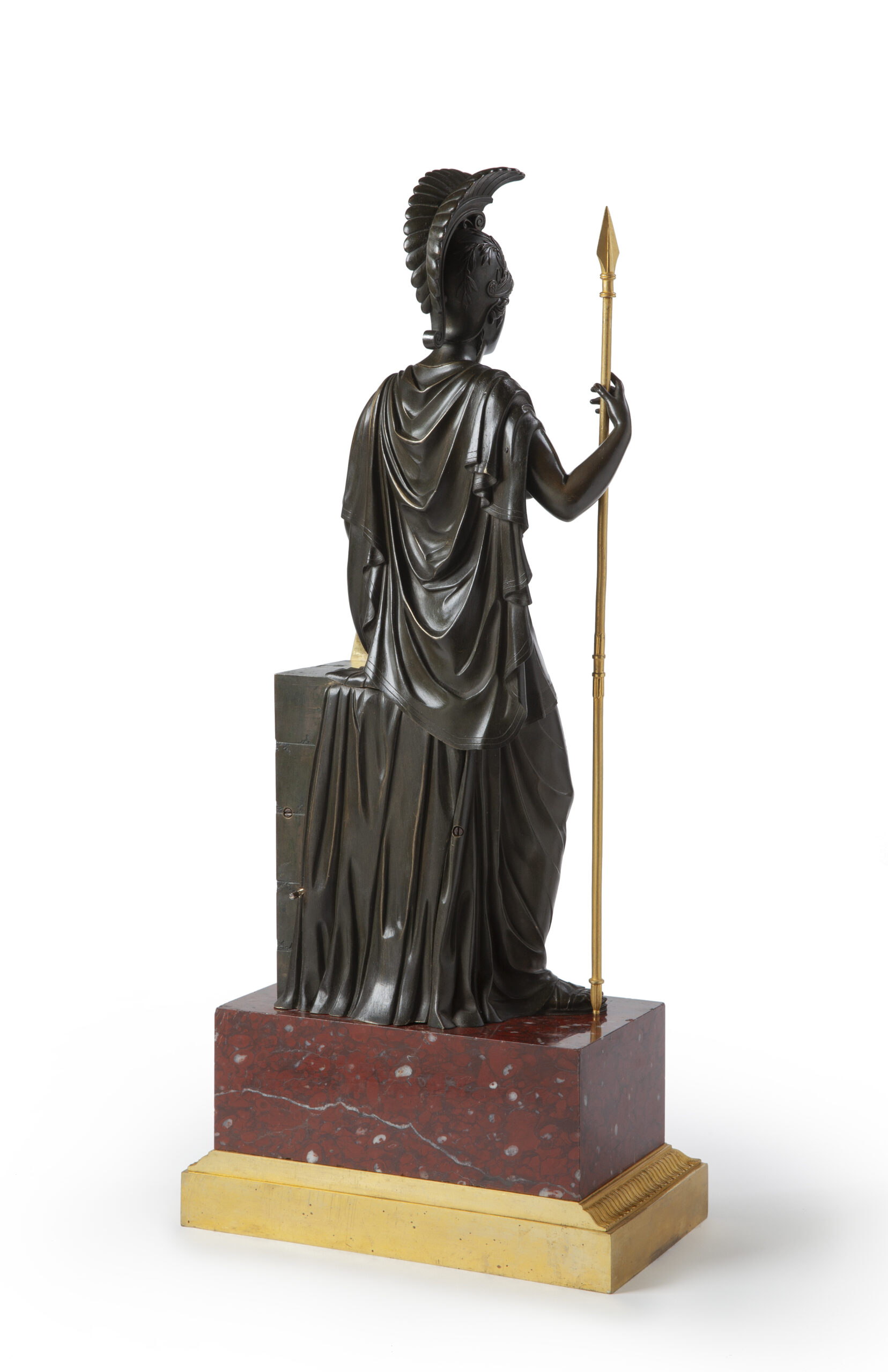
The case of this beautifully fire-gilt and patinated bronze mantel clock is dominated by the rising figure of Pallas Athena with a plumed helmet, a short tunic and a long cloak that is held together at the shoulder. She holds an ormolu spear in her right hand; her left hand rests on the shield-shaped dial. The rectangular red marble base has fine ormolu ornaments on the front and rests on a gilt bronze base.
Duration: 1 week
Height 59 cm
Width 26 cm
Depth 15 cm
Literature
– Tardy, Dictionnaire des Horlogers Français, p. 412.
– Tardy, Les Plus Belles Pendules Françaises, p. 278.
– Elke Niehüser, Die Französische Bronzeuhr, 1997, p. 229.
Note
The case is a representation of Pallas Athena, also known as Minerva, who was one of the twelve Olympian deities. She was worshipped as the goddess of wisdom and as the goddess of war and protected many Greek cities, especially Athens, which bears her name. According to mythology, she was the daughter of Zeus and sprang from his head fully armed. A virgin goddess who refused to marry, she was also a warrior goddess and took part in the battles of the gods against the giants. Because of her conquests, she is often associated with victory and is almost always depicted with a helmet and spear in her hand.