

POLYCHROME GOTHIC WALL CLOCK WITH AUTOMATON Ca. 1580 South-Germany
Iron wall clocks Wall clocks
M&R129a
POLYCHROME GOTHIC WALL CLOCK WITH AUTOMATON
Circa 1580
South-Germany
Movement
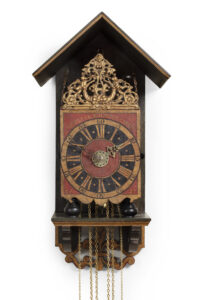
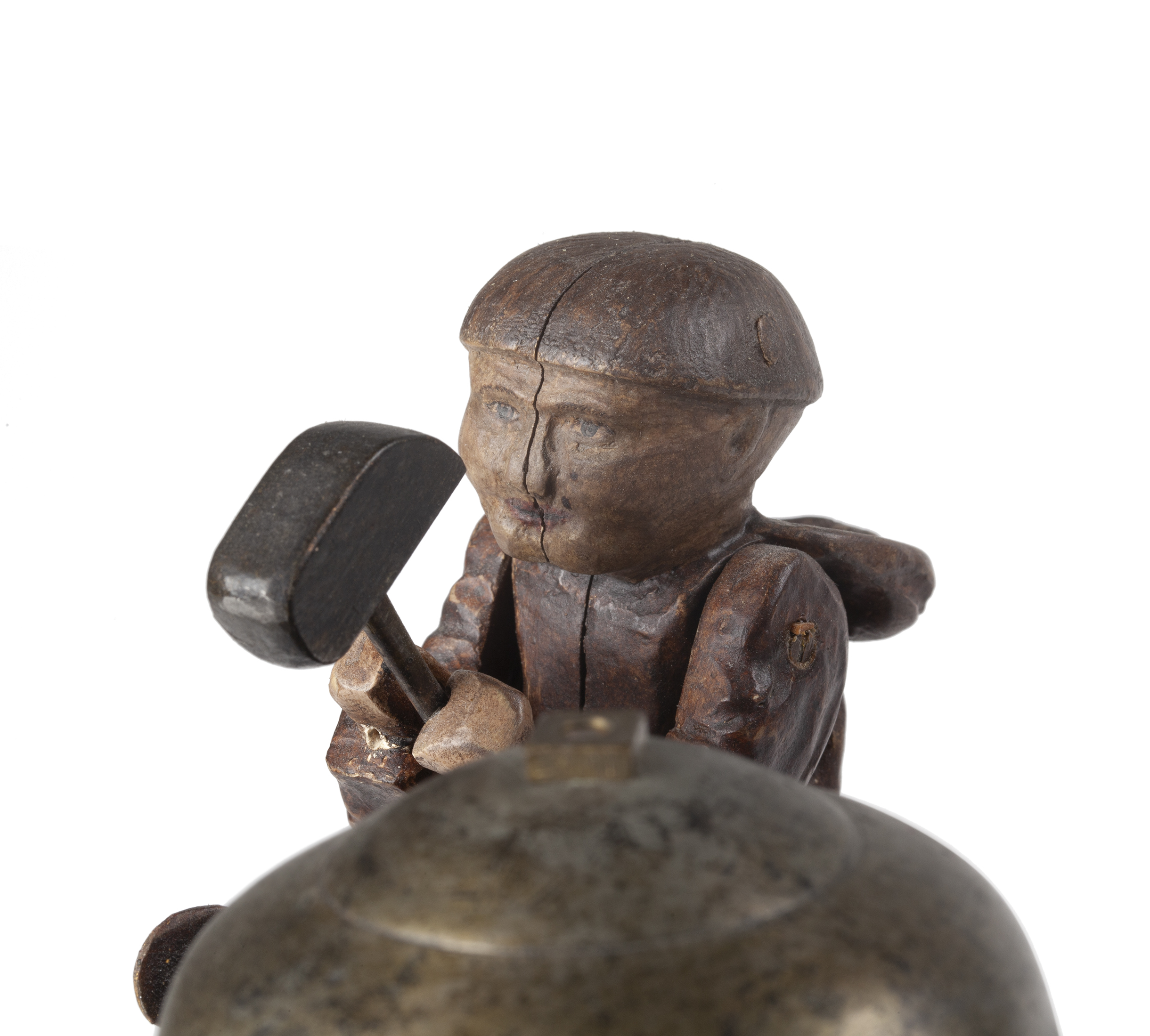
The weight-driven iron movement, constructed between bars, consists of going, striking and alarm trains. The going train has a vertical verge escapement with a balance. The striking, regulated by a countwheel, indicates the hours in full and the half hours with one stroke on a bell. At the prayer hours (3, 6, 9 and 12 o’clock) the automaton comes into operation, striking the hours on two bells.
Dial
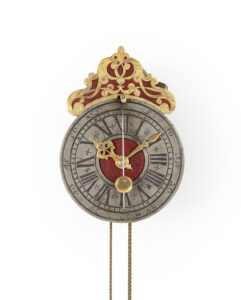
The arched iron dial is painted and has three chapter rings. The upper chapter ring is for the lunar date and has an aperture at the top behind which the phase of the moon is shown. The large chapter ring in the middle is for the time indication and has Gothic hour numerals with lozenge-shaped half-hour markers. In the middle is an alarm disc, which is painted with a star and Arabic hour numerals. The tail of the painted hour hand serves as a pointer for setting the alarm. The quarters are indicated on the lower chapter ring. The quarter numerals are Gothic, and a sunburst pattern is painted in the centre. All chapter rings have touch pieces.
Case
The polychrome painted iron case has a painted image of a female figure with an anchor in her hand on the left side. This is the personification of Hope. The woman on the right side has a chalice in her right hand and a cross in her left hand, the personification of Faith. All corners of the case are decorated with painted columns. These end in the arch at the top. Painted openwork iron frets are placed around the bells. The automaton on the top left corner of the cabinet represents a priest who strikes the smaller top bell with his hammer, a so-called Striking Jack
Duration: 12 hours.
Height: 28 cm.
Width: 12 cm.
Depth: 12 cm.
Literature
-Hall’s Iconographic Handbook, pp. 118 and 147.
– Fridolin Staub, Eine Sammlung alter Uhren.
-Gewerbemuseum Winterthur, Uhrensammlung Kellenberger Winterthur.
– Watches Rustique de la Collection Meister, Zurich, Musée International d’Horlogerie
-Lothar Krombholz, Frühe Hausuhren mit Wetsantrieb, Munich, 1984.