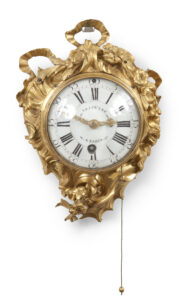
WALL CLOCK (OEIL DE BOEUF): de Belle Ca. 1790 France
M&R138a
WALL CLOCK (OEIL DE BOEUF)
Signed: de Belle
Circa 1790
France
Movement
The spring-driven brass movement consists of a going train and a striking train on demand. The going train has an anchor escapement and a short pendulum with wire suspension, which can be adjusted from the front with a small key. The striking train on demand indicates the hours and quarters with two hammers on a bell by pulling a cord.
Dial
The circular, white enamel dial has a chapter ring with Roman numerals, Arabic quarter hour, lozenge five-minute and minute divisions. The winding hole is located above the VI. The time is indicated by two beautifully pierced and engraved gilt brass hands. The maker has signed the clock under the XII: de Belle.
Case
The circular green patinated bronze case is embellished by a gilt brass pearl string. The dial is protected by a convex glass that is set in a gilt brass bezel with a pearl border. The case is surmounted by a gilt brass knob with a suspension eye.
Duration 1 week
Height 39 cm. (incl. suspension eye)
Diameter 26.5 cm.
Oeil de boeuf (ox eye)
This name for this type of wall clock is derived from the round or oval windows that were used for the palace in Versailles under Louis XIV. They are wall clocks with a round, oval or angular shape in a large number of varieties, often with a wavy edge.
Literature
Tardy, Dictionnaire des Horlogers Français, p. 158.
The maker
Jean-François De Belle worked at the Rue Saint-Honoré in Paris and became a master clockmaker in 1781. The clockmaker LeFevre succeeded him.